White supremacy · Anti-Black racism · Anti-Muslim extremism
Edward Weinhaus’ Devotion to a White Supremacist
He writes Tommy Robinson’s name as a chant, hails the people who stand by him as “the patriots” and, at a London rally, proposes renaming the far right the “very right.” The words are Weinhaus’ own. What follows is the record of the man they applaud.[1][2]
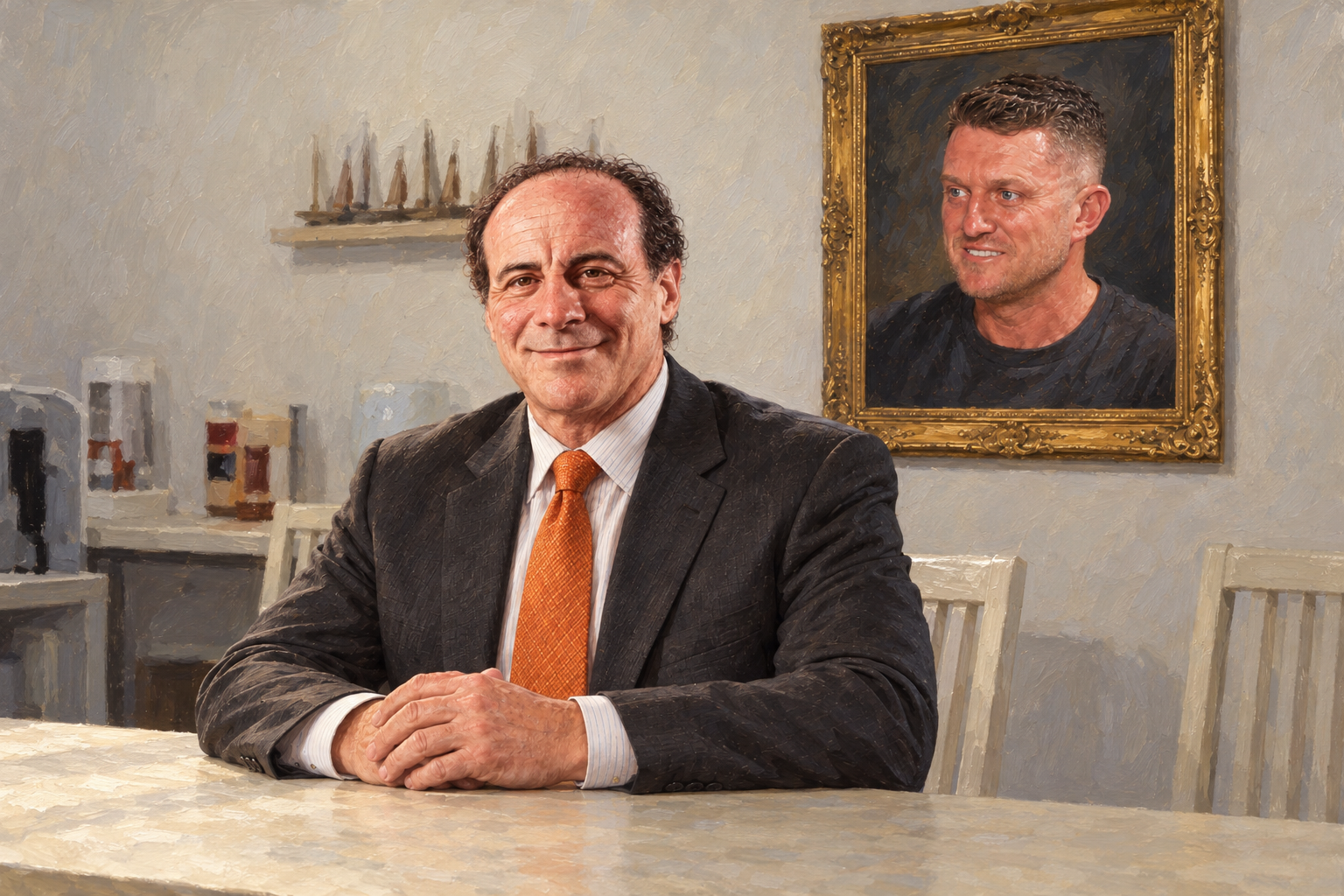
The far right, renamed
The video was filmed in London, at Robinson’s Unite the Kingdom rally. In it, Andrew Eborn asks Weinhaus about the far-right label, and Weinhaus offers the movement a promotion:
“Far right is probably better replaced with very right as opposed to very wrong.”Edward Weinhaus, interviewed at the Unite the Kingdom rally.[2]
It is not a correction. It is an endorsement. “Far” marks a movement’s distance from the mainstream; “very right,” set against “very wrong,” pronounces it correct. What Weinhaus says into a camera at the rally, he then forwards, as a kind of calling card, to someone he has yet to meet.
The racism behind the cause
For more than a decade, Robinson has insisted that his quarrel is with a religion, not a race. On May 15, 2026, an investigation by Nafeez Ahmed in Byline Times set that claim against more than 140 of his own posts. It found a consistent code: white people rendered as “natives,” non-white populations as “invaders,” Black identity repeatedly paired with crime. The remedy Robinson proposed was “Remigration and de-islamisation.” The investigation also identified anti-Black posts with no Muslim connection at all—posts in which, it concluded, the unifying thread was race.[3]
Calling this a free-speech cause does not answer the question of what the speech says. The investigation answers it: a hierarchy of belonging, drawn along racial lines. Weinhaus’ rally remarks give that substance a flattering name.
A day in the park
Olajuwon Ayeni is a Black musician from Redcar. He and his wife took their white granddaughters to a local park, and the family posted a video of the day. Robinson shared it with his 1.4 million followers. According to Cleveland’s Police and Crime Commissioner, the racist harassment of the family then escalated.
Two men confronted Ayeni and his wife in the street and threatened to “slash you up.” The couple became too frightened to leave their home. Ayeni’s management company suspended all business dealings. He said he felt he had to sleep “with one eye open.” When the commissioner’s office published its account, Robinson and others who had shared the video had yet to take it down, despite numerous appeals.[4]
This is what the cause looks like from the other end of a viral post: a family reduced to explaining to strangers that its own grandchildren are its grandchildren.
The boy who walked away
Jamal Hijazi came to Britain as a Syrian refugee. In October 2018 he was fifteen, his arm in a cast, when an older pupil grabbed him by the throat on a school playing field in Huddersfield, forced him to the ground and poured water over his face. Hijazi got up and walked away. The High Court would later record that at no point did he offer any violence.
When the footage went viral a month later, Robinson added his own account. In two Facebook videos, viewed almost a million times, he told his followers that Hijazi had, as part of a gang, taken part in a violent assault on a young girl and had threatened to stab another child.[5]
In July 2021, the High Court rejected Robinson’s defence of truth and awarded Hijazi £100,000. Mr Justice Nicklin found that Robinson had made a deliberate effort to recast the victim as a violent aggressor, in language “calculated to inflame the situation.” The abuse that followed was, the judge wrote, “entirely predictable.” It drove the family from their home and Hijazi from his education; he had been considering a career as a pharmacist. The judge expected some of the scars to last for many years, perhaps for life.[5]
The court also barred Robinson from repeating the allegations. He repeated them anyway—most prominently in a film he narrated, Silenced, which he played to a rally in Trafalgar Square in July 2024 and posted online, where one upload was viewed 44 million times within three weeks.[6]
In October 2024, Robinson admitted ten breaches of the injunction. Sentencing him to eighteen months in prison, less three days already spent in custody, Mr Justice Johnson noted that much of the film, considered in isolation, did not breach the injunction and was a lawful exercise of free speech. What was not lawful was the part that repeated the accusations against Hijazi.[6]
The speech had a victim. The victim had a judgment. Robinson kept publishing anyway.
Three years in his sleep
Weinhaus has his own way of talking about prison. In his June 4, 2026 correspondence with the Illinois attorney-disciplinary commission, he sums it up in one line, short enough to let him speak for himself:
Robinson’s own imprisonment ended in a different posture. After seven months inside, served under significant restrictions on his association with other prisoners, he asked the court to remit four months of his sentence. In two witness statements, the man Weinhaus calls a free speech advocate told the court he now understood that, if he disagreed with the injunction, the right course would have been to appeal it, not to breach it. He took steps to have the banned material taken down and promised to comply.[8]
On May 20, 2025, Mr Justice Johnson remitted the four-month coercive portion of the sentence. The judge recorded that Robinson had expressed no contrition or remorse. The injunction remained binding.[8]
Weinhaus boasts that he could do three years in his sleep. The man he cheers went to prison for defying a court order, and shortened his stay by promising to obey it.
He chose the chant
Behind the slogans, the record is made of people: a family in Redcar made afraid of its own doorstep; a refugee schoolboy who got up from the ground and walked away, only to be recast as a violent aggressor in videos viewed nearly a million times, then driven from his home and his education. These are not abstractions. They are what the conduct documented above has cost.
Weinhaus’ message treats criticism as a test of loyalty: the meek back away; the patriots stay. He writes that he yearns to advocate for free speech “within the confines of our law”—“even abroad.” The court had already distinguished lawful speech from Robinson’s prohibited accusations. Much of his film, considered in isolation, was lawful free speech. He still breached the injunction ten times.
The record was there for anyone to read. Weinhaus chose the chant. He gives Robinson the flattering label, the volunteered association and the cheer—and after his own signature, in capitals, he gives him the last word: “PS OYYYY TOMMY TOMMY !”[1]
Sources
- Weinhaus’ LinkedIn message praising Tommy Robinson.Subject: “Oyyyyy Tommy Tommy.” Message sent from Weinhaus’ LinkedIn account.
- Andrew Eborn’s interview with Edward Andrew “Coach” Weinhaus.Unite the Kingdom rally, London, May 16, 2026. Octopus TV / The Andrew Eborn Show.
- Nafeez Ahmed’s investigation of Robinson’s racial language.Byline Times, May 15, 2026. Analysis of more than 140 posts.
- Cleveland Police and Crime Commissioner’s statement on the Ayeni family.August 21, 2025. Official statement on the racist harassment and street threats directed at the Ayeni family.
- Hijazi v. Yaxley-Lennon, [2021] EWHC 2008 (QB).High Court, July 22, 2021. Cited paragraphs: 2–5, 22–31 and 150–163.
- HM Solicitor General v. Yaxley-Lennon, [2024] EWHC 2732 (KB).October 28, 2024. Cited paragraphs: 4, 57–62, 71–72 and 100–108.
- Weinhaus’ June 4, 2026 prison statement.His statement that he “could do three years in Maryland state prison in my sleep,” from correspondence with the Illinois ARDC.
- HM Solicitor General v. Yaxley-Lennon, [2025] EWHC 1237 (KB).May 20, 2025. Sentence-remittal judgment. Cited paragraphs: 5–7 and 13–15.